What Is a Dry Air Filter and How Does It Work?

A dry air filter removes airborne particles through a solid, non-wetted filter medium. It is common in HVAC systems, industrial ventilation, vehicles, and clean-air equipment. Unlike a dehumidifier, it does not remove moisture from air. Its job is particle control.

The U.S. Environmental Protection Agency reports that indoor pollutant levels can be two to five times higher than outdoor levels, with some pollutants exceeding outdoor concentrations by more than 100 times. This makes filtration a practical control measure, although no filter solves every indoor-air problem. A dry air filter usually combines several capture mechanisms. Fibers intercept particles, inertial forces drive larger particles into the media, and diffusion helps capture very small particles. Electrostatic effects may improve performance in some designs.

Performance depends on more than the label. ASHRAE Standard 52.2 evaluates HVAC filters by their Minimum Efficiency Reporting Value, or MERV. A higher MERV rating generally indicates stronger particle removal, but it can also increase pressure drop. That may raise fan energy use if the system was not designed for it. The U.S. Department of Energy identifies airflow resistance as an important factor in filtration energy performance.

The World Health Organization’s 2021 Global Air Quality Guidelines recommend an annual PM2.5 level of 5 micrograms per cubic meter. That target shows why filter selection deserves careful attention. Real results are messier. Poor sealing, overdue replacement, and overloaded media can sharply reduce protection. This guide explains how a dry air filter works, how to read performance claims, and where practical limits remain.
What Is a Dry Air Filter and How Does It Work?

Definition and Basic Purpose of a Dry Air Filter

A dry air filter is a filtration device that removes dust and other airborne particles without using oil or liquid. Its basic purpose is simple: protect equipment and improve the cleanliness of moving air. The filter usually contains pleated paper, synthetic fibers, or another porous material. As air passes through, particles become trapped in the filter media. Cleaner air then travels into an engine, ventilation unit, or enclosed workspace.

The filter does not remove every contaminant. Performance depends on media quality, airflow speed, particle size, and proper installation. A filter may look clean but still restrict airflow when fine dust fills its inner layers. In practical maintenance work, technicians often check pressure changes, unusual equipment noise, and visible dust around the housing. These signs can reveal trouble earlier than appearance alone. A loose seal can also let unfiltered air pass around the filter. That small gap matters.

Tips: Install the filter in the correct airflow direction. Keep the housing dry and tightly closed. Follow the equipment maker’s service interval, but inspect sooner in dusty areas. Do not wash a disposable dry filter unless its instructions clearly allow it. Reusing a damaged filter is a poor compromise. Sometimes, replacement timing requires judgment rather than a calendar date.

Main Components and Materials Used in Dry Air Filters

A dry air filter removes particles without oil or liquid coating. Its main structure is simple, but every layer affects performance. The filter media usually contains pleated cellulose, polyester, polypropylene, or fine fiberglass. Pleats increase surface area inside a compact frame. More area can reduce airflow resistance. Not always.

The frame may use galvanized steel, plastic, or rigid fiberboard. It keeps the media stable under airflow and vibration. A wire mesh or expanded-metal support prevents pleat collapse. Flexible gaskets seal the filter against its housing. Even a small gap can allow unfiltered air to bypass the media. In field inspections, this is often more important than the filter’s printed efficiency rating.

The U.S. Environmental Protection Agency reports that indoor pollutant levels can be two to five times higher than outdoor levels. That makes correct filter installation important in occupied buildings. ASHRAE Standard 52.2 evaluates particle removal through MERV testing, while ISO 16890 classifies filters by ePM1, ePM2.5, and ePM10 performance. Some dry filters also include activated carbon, which targets odors and selected gases rather than dust. Carbon adds weight and can increase pressure drop. A filter that looks clean may already be restricting airflow. Dust loading changes its behavior over time, so replacement intervals should follow measured pressure drop, operating conditions, and manufacturer data. The assumption that “thicker means better” needs reconsideration.

What Is a Dry Air Filter and How Does It Work?

Dry air filters remove airborne particles by passing air through a dry porous medium. Particles are captured through interception, inertial impaction, diffusion, and, in some filters, electrostatic attraction.

The chart shows representative fiber-diameter ranges commonly associated with major dry filter media. Actual values vary with manufacturing method, density, and filter construction.

How a Dry Air Filter Captures and Removes Contaminants

What Is a Dry Air Filter and How Does It Work?

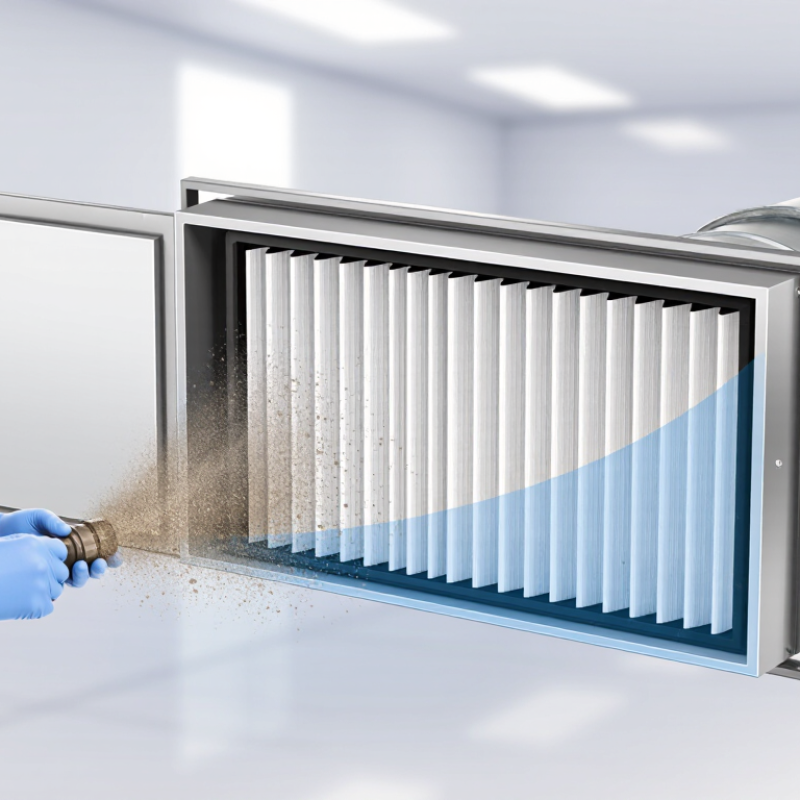
A dry air filter removes airborne particles without using oil or liquid. Air passes through a folded, fibrous material with many narrow paths. Dust, pollen, lint, and other particles collide with the fibers or become trapped between them. Larger particles often stop through direct impact. Smaller particles may follow the airflow, but diffusion helps capture some of them. The filter does not remove every contaminant. Gases, odors, and very tiny particles may pass through unless another treatment stage is used.

The filter works best when air moves through the media evenly. A tight frame and proper seal prevent dirty air from bypassing the filter. In real use, performance changes as dust builds up. The collected layer can improve particle capture, but it also increases resistance. You may notice weaker airflow, a noisier fan, or rising energy use. These signs are useful, though they are not perfect proof. Measuring pressure drop is more reliable when equipment allows it.

Tips: Check the filter’s size and airflow direction before installation. Inspect the edges for gaps or crushed material. Replace the filter according to measured loading, operating conditions, or the equipment manual. Do not wash a disposable dry filter unless its instructions clearly allow it. A clean-looking filter may still hold fine particles, so appearance alone can mislead.

What Is a Dry Air Filter and How Does It Work?

How a Dry Air Filter Captures and Removes Contaminants

Contaminant or Filter Feature Typical Particle Size or Rating Primary Capture Mechanism How the Dry Filter Removes It Important Operating Consideration
Household dust Approximately 1–100 micrometres (µm) Inertial impaction, interception and, for smaller particles, diffusion Particles collide with or adhere to fibers as air passes through the filter media. Dust-holding capacity depends on media area, fiber structure and airflow velocity.
Pollen Commonly about 10–100 µm Interception and inertial impaction The relatively large particles are unable to follow the air stream around fibers and become trapped. Higher-efficiency filters generally capture pollen more effectively, but may create greater airflow resistance.
Mold spores Typically about 10–30 µm, although sizes vary Interception and impaction Spores are retained within the depth or surface structure of the filter media. A filter captures spores from air; it does not remove established mold growth from surfaces or ventilation equipment.
Bacteria-containing particles Individual bacteria may be about 0.5–5 µm; airborne bacteria are often attached to larger droplets or particles Interception, impaction and diffusion The filter captures the particle or droplet carrying the microorganism rather than relying on biological inactivation. Capture performance depends on the tested efficiency, airflow rate, sealing and filter condition.
Fine particulate matter PM2.5: particles with an aerodynamic diameter of 2.5 µm or smaller Diffusion, interception and electrostatic attraction when charged media are used Very small particles move irregularly and are more likely to contact and remain on filter fibers. Efficiency should be evaluated at the intended airflow because performance and pressure drop change with velocity.
Smoke particles Often below 1 µm, depending on the source and combustion process Diffusion and electrostatic attraction Fine particles are captured as their random motion brings them into contact with fibers. Particle filters can remove smoke particles, but ordinary dry fiber media do not remove most smoke gases or odors.
Fibers, lint and hair Usually larger than 50 µm, with considerable variation Sieving, interception and impaction Large contaminants are blocked at the filter surface or caught in the first layers of media. Pre-filtration helps prevent rapid loading and extends the useful life of finer downstream filters.
HEPA-grade dry filter Commonly specified at 99.97% efficiency for particles of 0.3 µm under the applicable test conditions Interception, impaction and diffusion A dense network of fine fibers captures particles throughout the media depth; 0.3 µm is commonly used as a test reference because it is near the most penetrating particle size for many filter designs. Actual system performance also depends on gasket sealing, installation quality, airflow and filter loading.
Activated-carbon or sorbent layer Not a particle-efficiency rating; performance depends on sorbent mass and gas concentration Adsorption rather than mechanical particle filtration Some gases and odor molecules adhere to the internal surface of the sorbent material. A plain dry particle filter does not remove gases; sorbent capacity can be exhausted and varies by contaminant and humidity.
Pressure drop Varies with media design, airflow, filter area and dust loading Air resistance through the filter As captured material accumulates, the airflow path becomes more restricted and resistance usually increases. Filters should be replaced or serviced according to pressure-drop limits, airflow requirements or the equipment manufacturer's instructions.

Note: Particle-size ranges and removal performance are approximate. Actual results depend on filter construction, test method, airflow, installation sealing, humidity and the amount of material already collected.

Types of Dry Air Filters and Their Common Applications

A dry air filter removes dust and particles without using oil or water. Air passes through a dry, fibrous or synthetic media layer. Larger particles become trapped on the surface, while smaller particles collect between the fibers. As dust builds up, airflow resistance increases. That change matters in real equipment.

Panel filters are simple and affordable. They are common in residential ventilation units, office air handlers, and light commercial systems. Pleated filters provide more surface area in the same frame. They suit homes, schools, workshops, and many HVAC cabinets. Their folds can hold more dust, but a tightly packed filter may restrict airflow when neglected.

Bag filters use flexible pockets that expand as air moves through them. They are widely used in hospitals, factories, clean production areas, and large ventilation systems. Cartridge filters have compact, cylindrical designs and often serve industrial dust collectors, compressors, and engine intake systems. Some dry filters also use high-efficiency media for fine particles, including airborne dust from sanding or processing materials. Selection should match particle size, airflow volume, pressure limits, and maintenance access. A technician may measure pressure across the filter instead of judging it by appearance. It can look clean and still be loaded internally. No filter choice is perfect. A higher efficiency rating can reduce airflow if the system was not designed for it.

Maintenance, Performance Factors, and Replacement Guidelines

A dry air filter cleans incoming air through a pleated, dry filter medium. It captures dust before air reaches the engine or machinery. No oil bath is involved. Airflow passes through tiny passages, while particles remain on the fibers. As dust builds, resistance increases and available air decreases.

Maintenance should begin with the housing, seals, and restriction indicator. A damaged seal can let unfiltered air bypass the element. Check for cracks, loose clamps, moisture, and uneven dust marks.

Visual inspection helps, but it is not perfect. A filter may look clean while already restricting airflow. Avoid aggressive tapping or high-pressure air, which can tear the medium. Cleaning can also remove invisible fibers. This is an easy mistake to underestimate.

Performance depends on dust concentration, operating hours, humidity, airflow demand, and filter size. Heavy dust loads shorten service life quickly. A properly fitted element usually performs better than an oversized but poorly sealed one.

Replace the filter when restriction reaches the equipment maker’s limit, when the element is damaged, or when contamination remains after approved servicing. Do not rely only on a calendar interval. Record operating hours and inspection findings.

If fuel use rises, power drops, or black exhaust appears, inspect the intake system promptly. The filter may be responsible, but other faults can create similar symptoms.