
What Are the Top Fluid Pump Types in 2026?
Choosing a fluid pump in 2026 is not just a matter of moving liquid from one point to another. Flow rate, pressure, viscosity, solids, and maintenance access all shape the decision. A pump that performs well with clean water may struggle with abrasive slurry or thick food products. Small details matter.
Industry data helps explain why pump selection deserves careful attention. The U.S. Department of Energy’s Improving Pumping System Performance sourcebook notes that pumping systems account for nearly 20% of global electrical energy demand. It also reports that pumps can use 25% to 50% of the energy in some industrial operations. These figures make efficiency more than a technical footnote. Grand View Research valued the global pumps market at about USD 63.1 billion in 2022 and projected continued growth through 2030. That estimate covers a broad market, so it should not be read as a precise forecast for 2026.
This guide compares the main options: centrifugal pumps for high-volume transfer, positive-displacement designs for controlled flow and viscous fluids, and submersible pumps for submerged service. It also considers diaphragm, peristaltic, and axial-flow models where their operating characteristics fit the task. No single type wins every application. The best choice depends on the actual duty cycle, fluid properties, installation, and lifecycle cost—not a product label alone. In practice, specifications can look tidy while field conditions are not. A careful review of those conditions is essential.
How Fluid Pumps Work and How They Are Classified
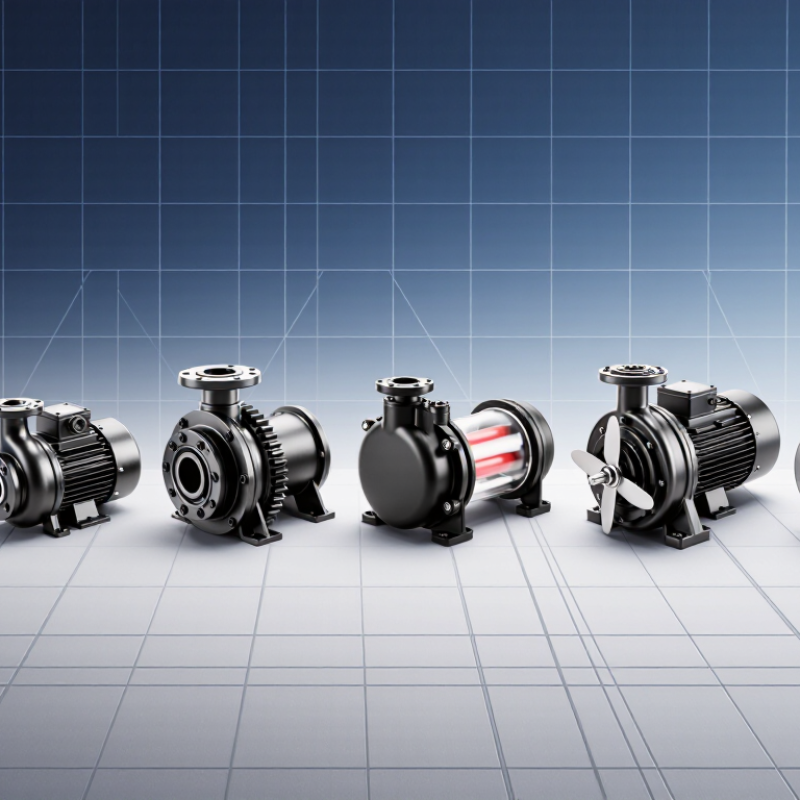
Fluid pumps move liquids by creating a pressure difference or mechanically displacing a set volume. Their main classes are dynamic pumps and positive-displacement pumps. A centrifugal pump, a common dynamic type, spins an impeller to give liquid speed; the casing then converts much of that motion into pressure. It suits steady flow, but performance can fall when the liquid is very thick.
Positive-displacement pumps trap fluid in a chamber and push it toward the outlet. Reciprocating models use a moving piston or diaphragm, while rotary models use gears, screws, or vanes. They can deliver measured flow across changing pressures, though seals and clearances need attention. This classification is useful, but real pump behavior also depends on fluid viscosity, temperature, pipe layout, and operating speed. The categories do not tell the whole story.
Tips: Match the pump to the actual liquid and duty cycle. Check the required flow, pressure, and solids content before selecting a type. For example, a thick syrup and a thin rinse liquid may need very different designs. Leave room for maintenance, too. Small details matter.
| Pump Type | Main Classification | How It Works | Typical Flow Characteristics | Key Strengths | Common Applications |
|---|---|---|---|---|---|
| Centrifugal | Dynamic; radial-flow | A rotating impeller adds velocity to the liquid, and the casing converts much of that velocity into pressure. | Continuous flow; performance varies with system resistance. | Simple construction, steady delivery, and suitable for many high-flow services. | Water supply, irrigation, cooling systems, and general process transfer. |
| Axial-Flow | Dynamic; axial-flow | Propeller-like blades move liquid mainly parallel to the shaft. | Very high flow at comparatively low head. | Efficient for moving large volumes through systems with low resistance. | Flood control, drainage, circulation, and large-scale water management. |
| Mixed-Flow | Dynamic; mixed-flow | An impeller moves liquid with both radial and axial components. | High flow at moderate head, between typical axial- and radial-flow service. | Balances flow capacity and pressure generation. | Water treatment, drainage, irrigation, and industrial circulation. |
| Gear | Positive displacement; rotary | Meshing gears trap liquid and carry it from the inlet to the outlet. | Nearly proportional to rotational speed; flow is generally smooth, with some pulsation. | Compact design and effective handling of many lubricating, viscous liquids. | Lubrication, fuel transfer, hydraulic systems, and metering duties. |
| Screw | Positive displacement; rotary | One or more rotating screws move enclosed volumes of liquid along the pump casing. | Continuous, low-pulsation delivery; suitable designs can handle viscous fluids. | Steady flow and relatively gentle handling in appropriate configurations. | Oil transfer, fuel systems, marine service, and industrial process duties. |
| Vane | Positive displacement; rotary | Sliding vanes in a rotor form changing chambers that draw in and discharge liquid. | Steady displacement per revolution, subject to operating conditions and wear. | Compact construction and useful performance with clean, lubricating liquids. | Hydraulic equipment, fuel handling, and lubricant circulation. |
| Diaphragm | Positive displacement; reciprocating | A flexing diaphragm changes chamber volume; check valves direct liquid through the pump. | Often pulsating flow; air-operated designs can run without an electric motor at the pump. | Can isolate the fluid from moving drive components; material selection supports a range of chemicals. | Chemical dosing, wastewater, slurries, and transfer of corrosive or sensitive liquids. |
| Peristaltic (Hose or Tube) | Positive displacement; rotary | Rollers or shoes compress a flexible tube, pushing liquid forward without contacting the pump head. | Metered, pulsating flow; output is related to rotor speed and tube size. | Fluid contacts only the tubing; useful for abrasive, viscous, or shear-sensitive fluids when properly specified. | Laboratory dosing, food processing, water treatment, and chemical transfer. |
| Piston or Plunger | Positive displacement; reciprocating | A moving piston or plunger changes chamber volume while inlet and discharge valves control flow. | Pulsating delivery; capable of high pressure in suitable designs. | Accurate displacement and high-pressure operation for compatible fluids and materials. | Pressure washing, metering, hydraulic service, and high-pressure process applications. |
Related Posts
-
Exploring the Innovations in Fluid Pump Technology and Their Impact on Energy Efficiency
-
Why Choose a Fluid Pump for Your Industrial Applications?
-

2025 Top Oil Pumps: The Best Digital Solutions for Efficiency and Performance
-
What is the Function of Oil Pumps in Automotive and Industrial Applications?
-
How to Choose the Right Air Tool Oil for Your Needs?
-
Top Fuel Pumps Explained What You Need to Know?