
Choosing a Chinese Led Garden Light manufacturer is not simply a matter of comparing prices. A low quote may hide differences in optics, materials, testing, and support. In a garden, those details become visible after rain, during long summer evenings, and through changing seasons. One fixture may cast a clean path of light; another may leave dark patches beside the same hedge.
This overview compares manufacturers through practical factors: product range, housing and lens choices, lighting performance, customization, quality control, and export experience. Plant-lighting researcher Dr. Bruce Bugbee’s guidance can be paraphrased this way: “Measure light where plants grow, not only at the fixture.” That principle also encourages buyers to ask for photometric data instead of relying on wattage alone. Still, no single specification tells the whole story. It is easy to overlook installation conditions.
The manufacturers discussed here serve different needs, from residential paths to larger landscape projects. Their strengths should be judged against a buyer’s application, budget, and service expectations—not treated as a universal ranking. Useful questions include how a supplier tests outdoor products, whether sample units are available, and how clearly it documents materials and performance. A polished catalog is helpful, but it is not proof of long-term reliability. This comparison offers a starting point, not a substitute for checking samples, specifications, and references.
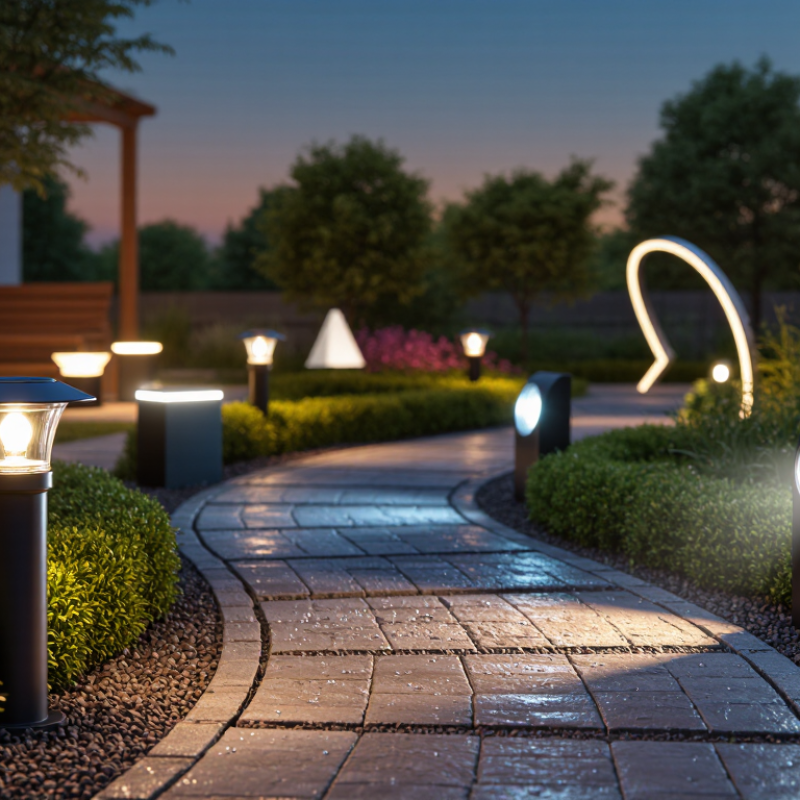
LED garden lights are outdoor luminaires that use light-emitting diodes to illuminate paths, planting beds, patios, and entrances. Common forms include low bollards beside walkways, spotlights aimed at trees, and wall-mounted fixtures near doors. They can run from mains power, low-voltage transformers, or integrated solar panels. Choose beam direction and brightness for the task: a narrow beam can highlight a trunk, while softer, shielded light helps keep a seating area comfortable. Small details matter. Wet soil, exposed cable connections, and changing plant growth can affect performance, so placement and suitable outdoor-rated equipment deserve attention.
Their value is not only decorative. The U.S. Department of Energy’s Energy Saver guidance reports that LEDs use at least 75% less energy and can last up to 25 times longer than incandescent lighting. These comparisons describe light sources, not every complete garden fixture or real-world installation. That distinction is easy to miss. For practical use, consider operating hours, maintenance access, glare, and whether solar panels receive enough direct sun. A bright fixture may still be poorly chosen if it shines into a neighbor’s window or washes out the garden’s natural texture. Lighting should help people move safely and notice specific features, not turn every corner into daylight.
China’s LED garden light industry has evolved from assembling simple outdoor fixtures into a broad manufacturing ecosystem. Earlier products often relied on conventional lamps, basic housings, and straightforward wiring. As LED chips, drivers, and optical components became more accessible, factories began redesigning luminaires for lower energy use and longer service life. The shift was gradual. Suppliers expanded their capabilities in metal forming, powder coating, lens selection, thermal management, and driver testing. These details matter in a garden: a poorly sealed joint may fail after repeated rain, while trapped heat can shorten component life.
Today, manufacturers produce bollard lights, spike lights, wall fixtures, and pathway systems, often with choices such as warm color temperatures, dimming, and photocell control. A broader supply chain can shorten development cycles. Yet capabilities vary. Some factories conduct optical simulations and aging tests in-house; others rely on outside partners. Buyers should check sample performance and production consistency rather than assume every specification is verified equally. Export demand has also brought greater attention to corrosion resistance, wiring protection, and packaging for long-distance shipping. Progress is uneven. Price pressure can mean thinner materials or limited testing, a trade-off worth examining carefully. The industry’s development is not only about adding more LEDs; it is also about making outdoor lighting more dependable and better suited to real gardens.
Selected national policy and standards milestones relevant to the growth of LED lighting, including outdoor applications.
This is a chronology, not a measure of market size or a ranking of manufacturers. Milestones shown: the “Ten Cities, Ten Thousand Lights” demonstration program (2009); China’s incandescent-lamp phase-out roadmap (2011); and publication of LED lighting energy-efficiency standard GB 30255-2013 (2013).
Leading Chinese LED garden-light manufacturers should prove performance with traceable test records, not impressive wattage claims alone.
The U.S. Department of Energy’s Energy Saver guidance says LED bulbs use at least 75% less energy and can last up to 25 times longer than incandescent bulbs. Treat that as a technology benchmark, not a promise about an outdoor fixture. Ask for an LM-79 report covering the complete luminaire’s light output and distribution. LM-80 and TM-21 data can help assess LED-source depreciation, but do not establish the lifetime of the whole fitting. That distinction matters. Review the test laboratory, report date, model number, and whether the tested sample matches the production unit.
Outdoor durability needs equally concrete evidence. Check the stated IP rating against the site’s rain, dust, and irrigation exposure, then request records for thermal, corrosion, and ingress testing. A garden light may look sound on a showroom bench and still fail around a poorly sealed cable entry.
Ask how production batches are checked, how components are traced, and what replacement parts remain available. Inspect warranty terms and sample units; a datasheet can still flatter. Factory audits and documented corrective actions offer stronger evidence than broad claims about quality. A few details may be missed, so compare reports with the actual installation conditions.
Notable LED garden light manufacturers in China are distinguished by more than product catalogs. Look for teams that can explain optical design, heat control, and material choices in plain terms. A useful supplier provides clear photometric data and sample test reports, not just polished product photos. Ask how the fixture handles rain, soil moisture, and summer heat. Small details matter.
Manufacturing capability also shows in consistency. Request samples from different production batches, then compare finish, wiring, seals, and light output. Check whether the supplier can customize beam angles, color temperature, mounting hardware, and packaging without changing specifications unexpectedly. Ask about quality checks and warranty terms in writing. A capable maker should answer with specific processes. Yet no factory is perfect; response speed and documentation can vary, so verify claims before placing a large order.
Tips: Test a sample outdoors for several weeks. Inspect seals after rain, and note whether the light shifts color or flickers. Compare measured brightness with the stated specifications. A modest trial can reveal problems that a brochure misses.
| Evaluation Dimension | Relevant Data or Standard | What to Check When Comparing Manufacturers |
|---|---|---|
| Ingress protection | IEC 60529 defines IP ratings. IP65 indicates dust-tight protection and protection against water jets; IP66 indicates protection against more powerful water jets. | Confirm the IP rating applies to the complete assembled luminaire, and request a test report for the exact model and configuration. |
| Impact resistance | IEC 62262 defines IK impact-protection ratings. IK08 corresponds to 5 joules; IK10 corresponds to 20 joules. | Check whether the rating covers the assembled fixture, including its lens or diffuser, rather than only a component. |
| Photometric performance | IES LM-79 describes measurements of the electrical and photometric performance of solid-state lighting products. | Request a model-specific report showing measured input power, luminous flux, efficacy, color characteristics, and test conditions. |
| LED package lifetime evidence | IES LM-80 covers maintenance measurements for LED packages, arrays, and modules; IES TM-21 provides a method for projecting long-term lumen maintenance from test data. | Distinguish LED-source test data and projections from the expected service life of the complete outdoor luminaire. |
| Corrosion resistance | IEC 60068-2-52 specifies cyclic salt-mist testing. Results depend on the test severity, duration, materials, and sample construction. | For coastal or humid sites, request the full test conditions and verify that the tested sample uses the same housing, coating, fasteners, and finish. |
| Electrical safety | IEC 60598-1 sets general requirements and tests for luminaires; applicable product-specific requirements depend on the luminaire design and market. | Check that certificates or reports identify the relevant product model, power supply, wiring configuration, and destination market. |
| Outdoor operating suitability | Operating-temperature limits are product-specific and should be stated in the manufacturer’s technical documentation. | Compare the declared ambient-temperature range with the project climate, and ask how thermal performance was evaluated in the complete fixture. |
| Optical distribution | Beam angle and luminous-intensity distribution are model- and optic-specific photometric characteristics. | Request an IES or equivalent photometric file and verify that the distribution suits the garden paths, planting areas, or other intended application. |
| Quality-control traceability | Inspection records, component specifications, and production-batch identification are practical evidence of manufacturing controls; their availability varies by supplier. | Ask for sample inspection records, incoming-component controls, final-test procedures, and a method for tracing delivered units to a production batch. |
| Warranty and after-sales support | Warranty duration, coverage, exclusions, and remedies are commercial terms set by each supplier, not a universal product standard. | Compare written warranty terms, replacement-part availability, response process, and coverage for drivers, LEDs, finishes, and water ingress. |
| Customization and project support | Available options—such as mounting, finish, optics, controls, and cable entry—are specific to each product and production arrangement. | Confirm options in a model-specific specification, and verify that samples and production units will use the same approved configuration. |
When comparing LED garden light manufacturers, look beyond catalog photos and headline prices. Ask for fixture drawings, LED and driver specifications, photometric files, and test reports. Check whether the stated IP rating suits your site’s rain exposure and cleaning routine. For coastal gardens, ask how housings, fasteners, and coatings resist corrosion. A polished catalog is not proof of long-term performance.
Request a sample and test it in a realistic layout. Observe beam spread on paths, color consistency across units, glare near seating, and heat after several hours. Review how the manufacturer inspects incoming components and finished products, and ask about batch traceability, warranty handling, replacement parts, and production lead times. If specifications change between sample and order, get the differences documented. No checklist catches everything.
Tips: Compare like with like: wattage, lumen output, optics, materials, and warranty terms. Ask for clear answers in writing. A low quote may still be suitable, but unexplained gaps deserve another look.